Here is a more detailed explanation of the puzzle games for kids that can help improve their mind power, critical thinking skills, logical reasoning, problem solving, concentration and focus, . . . etc

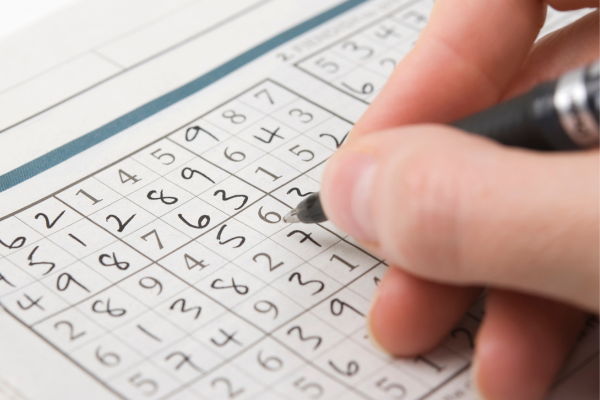
Sudoku is a popular puzzle game that involves filling a grid with numbers. The grid consists of nine rows and nine columns, divided into nine smaller squares called “regions.” The objective is to fill each row, column, and region with the numbers 1 to 9, ensuring that no number is repeated within the same row, column, or region.
Sudoku is a great game for kids to improve their mind power and critical thinking skills. Here’s a explanation of how Sudoku helps develop various cognitive abilities:
- Logical Reasoning: Analyzing available numbers and making logical deductions.
- Problem-Solving: Breaking down the puzzle into manageable parts and strategizing.
- Concentration and Focus: Maintaining attention to detail throughout the puzzle-solving process.
- Memory Enhancement: Remembering numbers and tracking progress.
- Pattern Recognition: Identifying and applying patterns for efficient decision-making.
- Numerical Skills: Enhancing understanding of numbers, sequences, and mathematical concepts.
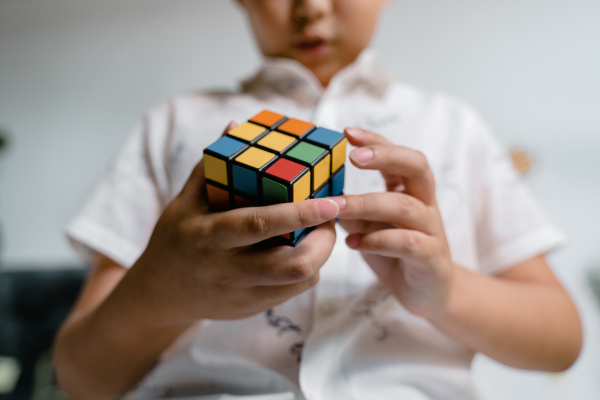

Rubik’s Cube is a three-dimensional mechanical puzzle that was invented by Ernő Rubik in 1974. It consists of a 3x3x3 cube with each face divided into nine smaller colored squares. The objective of the game is to solve the cube by manipulating its individual blocks to align the colors on each face, creating a uniform color on each side of the cube.
Here is a list of abilities that Rubik’s cube help to develop:
- Spatial Awareness: Manipulating the cube’s blocks improves kids’ understanding of spatial relationships and object manipulation.
- Problem-Solving: Solving the Rubik’s Cube requires strategy, logical thinking, and the ability to plan ahead.
- Concentration and Focus: Solving the cube requires sustained attention and concentration on the task at hand.
- Critical Thinking: Kids learn to analyze the cube’s current state and develop strategies to reach the desired solution
- Logical Reasoning: It develops kids’ logical thinking skills as they apply algorithms and systematic approaches to solving the cube.
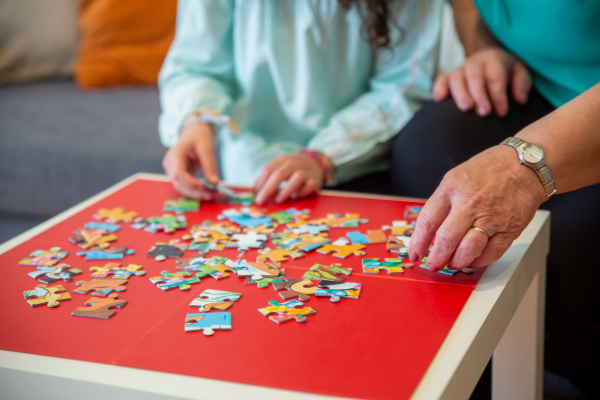
Jigsaw puzzles are a popular form of puzzle that consists of numerous small, uniquely shaped pieces that fit together to form a complete image. The pieces are typically cut from cardboard or wood and feature different shapes and patterns. The objective of the puzzle is to assemble the pieces correctly to recreate a specific picture.
Here is a list of abilities that Jigsaw Puzzles help to develop:
- Pattern recognition: Kids learn to identify patterns and shapes within the puzzle pieces.
- Logical thinking: Kids develop logical thinking skills as they analyze and plan their approach to solving the puzzle.
- Problem-solving abilities: Jigsaw puzzles require children to problem-solve by finding matching pieces and figuring out their correct placement.
- Visual perception: Children enhance their visual perception skills by observing the puzzle pieces, colors, and patterns.
- Cognitive flexibility: Jigsaw puzzles encourage flexible thinking as children explore different strategies to solve the puzzle and adapt their approach as needed.
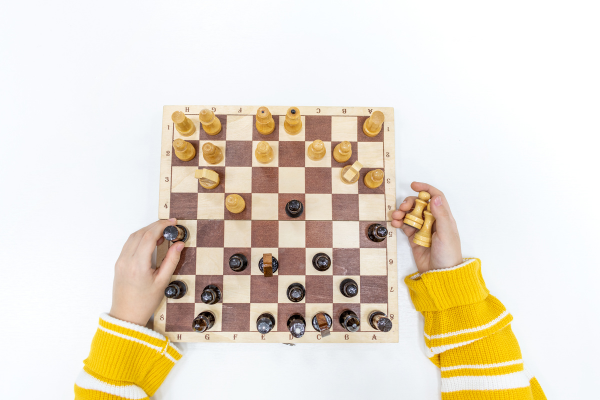

Chess is a strategic board game that has been played for centuries. It is played on a square board divided into 64 squares of alternating colors. Each player starts with 16 pieces, including a king, a queen, rooks, knights, bishops, and pawns. The objective of the game is to checkmate the opponent’s king, which means placing the king in a position where it is under attack and cannot escape capture.
Here is a list of abilities that chess help to develop:
- Critical thinking: Chess requires players to think critically and strategically, analyzing multiple possibilities and evaluating the consequences of their moves.
- Planning: Players must plan their moves ahead of time, considering the potential outcomes and anticipating their opponent’s responses.
- Decision-making: Chess teaches children to make decisions under pressure, weighing the advantages and disadvantages of different moves.
- Problem-solving: Chess presents complex problems that players must solve by finding the best moves and strategies to overcome obstacles and achieve their goals.
- Memory improvement: Chess involves remembering past moves, patterns, and strategies, enhancing memory skills and recall abilities.
- Concentration and focus: Playing chess requires sustained attention and concentration, as players must carefully analyze the board and consider various options.
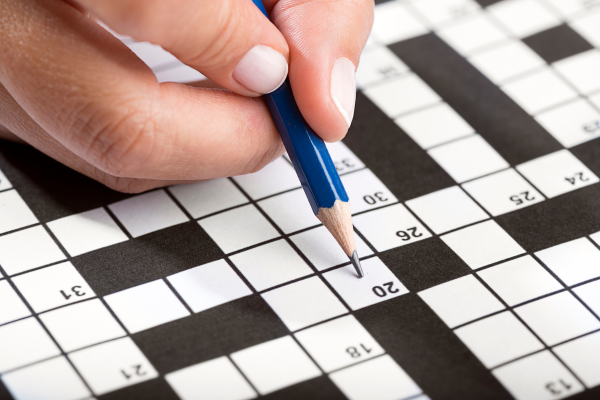
Crossword puzzles are word games that require filling in blank spaces in a grid with words based on given clues. The grid consists of intersecting horizontal and vertical boxes, forming a pattern of white and black squares. Each white box represents a letter, and the goal is to find the correct words that fit the provided clues.
Here are the abilities that crossword puzzles help in developing:
Vocabulary Expansion: Crossword puzzles expose kids to a variety of words and their meanings. They learn new vocabulary and expand their language skills as they encounter words from different fields and topics.
Word Recognition: By solving crossword puzzles, children improve their ability to recognize words based on their length, structure, and provided clues. They enhance their word-reading skills and become familiar with different word patterns
Critical Thinking: To complete a crossword puzzle, children need to analyze clues, consider different possibilities, and evaluate potential answers. They develop critical thinking skills as they weigh options and make informed decisions.
Memory Enhancement: Solving crossword puzzles requires recalling information, such as word definitions, synonyms, and context.